


Six Hills
Hertfordshire is a well-heeled English county situated directly north of Greater London, and home to many commuting folk. Stevenage, where the Hills are located, is a prosperous town towards the northern border of the county on the old Great North Road.
Local legend claims that the peculiar tumuli (barrows) were the work of the Devil, who, whilst loafing by the Great North Road, amused himself by lobbing huge piles of earth at startled passers-by.

A notoriously bad shot, Old Nick missed the road no less than six times which so thoroughly enraged him that he chucked a seventh clod over his shoulder, hitting Stevenage’s Graveley church spire and knocking it askew, which it remains to this very day.
The nearby pits in Whomerley Wood supposedly show where the Devil clawed out his missiles...
The neighboring village of Anstey also has connections with the ‘Horned One’. From Herts Memories:
The Devil’s Hole is a tunnel rumoured to run from a chalk pit called Cave Gate to the castle. It’s said that no-one had dared explore to find out the truth of the story until one night, at least two centuries ago. A blind fiddler called George was playing and drinking at the Chequers (now called The Blind Fiddler) in the village when talk turned to the Devil’s Hole. Having had a number of drinks and “grown quarrelsome and pot-valiant”, George declared that he, his fiddle and his dog would venture into the tunnel and find out the truth of the matter. George walked to Cave Gate and declared he’d follow the tunnel “though the Devil himself were at the end of it.” As he entered the cave, led by his dog, he called to the villagers to follow his progress above ground by the sound of his fiddle. Then he vanished from sight, and the unearthly sound of an unknown fiddle tune rose from beneath. The villagers followed it across the fields until they were about halfway to the castle. At that point the fiddle rose to a nightmarish shriek and stopped. Only silence came from the tunnel. The people rushed back to Cave Gate just in time to see the dog race out. His tail was gone and his hair singed off, and he ran off into the darkness howling as if all the devils in Hell were behind him, never to be seen again. Blind George, too, was never seen again, and it was generally assumed that the Devil had indeed been there to meet him. No-one ventured in to find out, though, and soon afterwards the entrance was sealed up, both to deter the foolhardy and to prevent George’s ghost from escaping.
The story of Blind George and the Devil’s Hole has a character all of its own, though. It’s inspired at least two songs. The Light of Day (which assumes the whole thing was an elaborately staged trick by George) is by the classic folk-rock band Fairport Convention and can be found on their 2002 album XXXV, while a lesser-known song, Blind George by the band Litha.
Note: This Blind George video may not be available to view in all countries.
Incidentally, Anstey’s St George’s Church is notable for its rare paganistic carvings of Mermen, the subject of a previous investigation of mine. The only other example in England is at the church of St Peter in Cambridge.

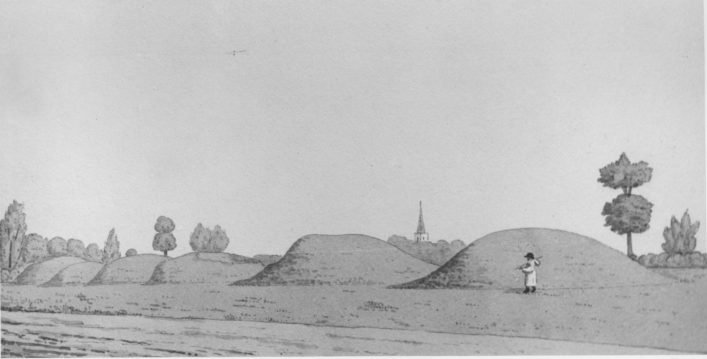
The Six Hills, which are very probably Roman burial mounds dating from about 100 A.D. marking the cremated remains of a wealthy local family, have not been the focus of any recent archaeological excavations, but early investigations in 1741 found "...a few pieces of wood and a piece of iron...". A farmer moved earth from the area in 1750, and there was an attempted widening of the Great North Road in 1820 which apparently encroached on the site. Over the centuries, the Hills have all lost over 4 feet (1.2 m) in height.
Aside from Satan, other supernatural happenings are associated with the Six Hills. This, from makingofmagic:
A spectral black dog is said to haunt the neighbourhood of the Six Hills. The story re-appears in 1911 in W.B. Gerish’s ‘Folk-Lore of Hertfordshire’ after he received a letter from a lady who reported that while walking near the hills she saw a shadow appearing out of the earth. She wrote that it was a large black dog, as big as a donkey, head bent towards the ground and its tail curled over its back, that disappeared as it passed them. The letter also tells of a gamekeeper who had seen the same apparition in a similar place; the dog first rushed at him, then as he turned, followed him, before disappearing in the direction of the hills.
The Stevenage ghost dog, which frequents (…) the Six Hills (…) may reasonably be identified with the devil, who according to (…) legend, threw shovelfuls of earth from the wood to make the Six Hills.
Herts Express, 11th November, 1911
A post on Facebook stating that they had seen a black dog late at night in the 1970s in the area of the hills. There is also a report of a 2012 sighting of a bloodied spectral man in the area. However, it seems that with the envelopment of the hills by the new town, any published materials on folklore about them has disappeared.
If you ever, for any reason, find yourself in Stevenage, you may wish to check out some other paranormal places in the town, aside from the Six Hills, including:
The White Lion Public House - the unquiet spirit of Henry Trigg
Former NatWest Bank, Old Town High Street - The tread of footsteps, scratching, a strange rustling noise together with banging and crashing sounds have been heard. Doors have been seen to open and close by themselves while in July 2014 a glowing white shape was caught on CCTV during a night time thunderstorm.
Monks Wood - headless monks
And the ‘Pie-Man’ and ‘Little Old Lady Of The Lane’, just two of the eerie residents of the very spooky Datchworth (Hertfordshire’s Most Haunted Village), down the road from the town:
The ‘Pie Man’ was highwayman Walter Clibbon, who was eventually shot and buried by the road at Oakenvalley Bottom, with a wooden post stuck into his grave (and apparently through to his chest) to prevent his shade from walking. But tales say you can sometimes see a ghost lurking in the area around the post, which is replaced when the previous one rots.

Datchworth’s All Saints Church, the Church with the Witches Hat, is known for the creepy sound of chanting coming from graveyard, whilst shadowy apparitions are often seen capering among the tombstones, even in daytime.

The village also boasts a whipping post, last known to have officially been used on July 27th 1665 when two vagabonds were publicly flogged here.

Appendix: Devilish doings in Hertfordshire:



My investigation into other Roman tumuli in England:


Stephen Arnell’s novel THE GREAT ONE is available on Amazon Kindle NOW:
https://www.amazon.co.uk/Great-One-Secret-Memoirs-Pompey-ebook/dp/B0BNLTB2G7
Sample:
Review: