


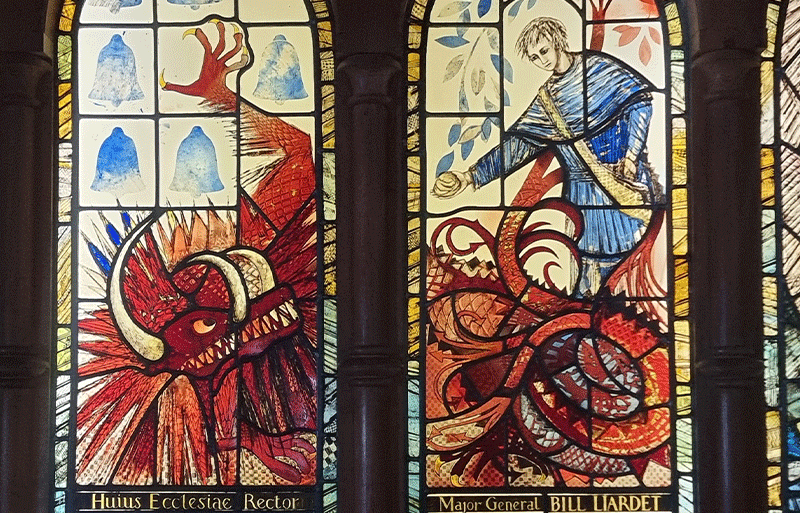
A stained-glass screen of creatures represents the local legend of the killing by poisoned pie of the Lyminster Knucker (a water monster/dragon).

Forget Scotland’s Nessie, Wales’s Afanc, and Windermere’s Bownessie; forget even Cornwall’s legendary sea-serpent Morgawr and look to the many creatures of myth and legend that lurked (or indeed lurk) in fair England’s lakes and rivers, some of whom I present to you:
The Knuckers of Sussex
It was (and may still be) believed that Knuckers, were/are a kind of Water Dragon found in the incalculably deep ponds, called ‘Knuckerholes’ of villages and towns of the southern English county of Sussex (less than 90 miles from London), including Binsted, Lyminster, Lancing, Shoreham and Worthing.
What is a Knuckerhole?
A very deep round pool, thought to to be of infinite depth. The Knuckerhole in Lyminster is only thirty feet (9.1 m) deep, although local lore says that the local bumpkins tied together the six bell ropes from the church tower and lowered them into the pool, failing to reach the bottom.
"A giant, slithering sea serpent's body, and cold, bold sea serpent's eyes and a deadly, hissing sea serpent's mouth" (Lewes Castle Learning Resource 2011)
The name Knucker has an interesting etymology, coming from the Old English Nicor, meaning "water monster"; it may also be related to "nixie", which is a form of water spirit, or to the words "Nykur" (Icelandic Water Horse), "Nickel" (German goblin), "Knocker" (Cornish goblin), "Näcken"/"Neck" (Scandinavian water spirits), "Näkineiu"/"Näkk" (Estonian mermaid/ singing water animal), and "Näkki" (Finnish water spirit)." So the linguistic lore is rich for such a relatively obscure creature.
According to legend the most fearsome Knucker lived at Lyminster; the beast was known to devour local livestock and even some more elderly villagers, but after the dragon began to consume some of the sturdier, less work-shy hayseeds, it was naturally decided to do away with the monster.
How the Lyminster Knucker was slain
A number of tales recount how the beast was eliminated; in one, the dragon slain by a gallant knight-errant after the (Saxon?) King of Sussex offered his daughter's hand in marriage to whoever slew it. After offing the dragon and marrying the princess, the knight settled in Lyminster and his gravestone, the Slayer's Slab, can still be seen in Lyminster church (see below).
In an alternative, more working class scenario, the dragon was outwitted by a local farmer's boy, after the Mayor of scenic local burg Arundel offered a sizeable financial reward. The lad killed the dragon by cooking it a huge poisoned pie, which he took to the Knuckerhole on a horse and cart. The dragon ate it ALL up - the pie, plus horse and cart. When the creature carked it, the boy carved off its ugly head to gain the reward.
A Roman Marsh Dragon, a cousin to the Knucker?

However the yokel had inadvertently wiped some of the poison on the side of the golden goblet gifted him by the grateful Mayor, which he consumed when toasting his own prowess. The Mayor reclaimed said goblet after his servants washed it in the Knuckerhole.
A lesson to us all.
The Slayer's Slab at Lyminster; the stone has a cross on it overlaying a herringbone pattern, but no inscription to identify the tomb's occupant, often the fate of the lower classes in medieval times of the cunning serf. Or alternatively, the name simply wore off.

The Knuckerhole today
The pond is fed by a nearby spring and remains fresh throughout the year; once open to all, it is now fenced off to protect the valuable trout that breed within it. Another case of wealthy landowners screwing over everyone else, I guess.

The Chanctonbury Dew Pond in West Sussex; typical for coastal Sussex in the area around Worthing where they were once said to be the home of their very own Knucker.

Grindylows
Best known nowadays as creatures in J.K. Rowling’s Harry Potter series of children’s books and films, the Grindylows actually date all the way back to Anglo-Saxon times.
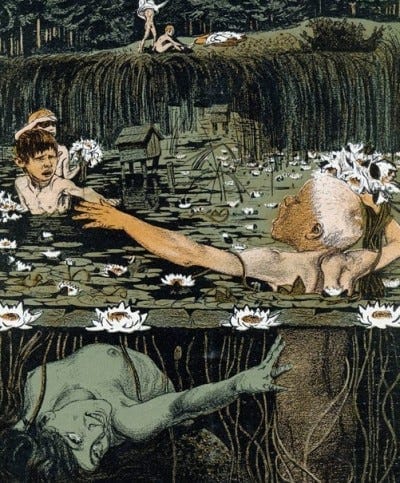
Evil goblin-like aquatic entities with green skin and skinny limbs, these small, malevolent pests reach out from their mires to grab children, dragging them to their deaths in the depths. Most Grindylow myths seem to originate from either Yorkshire or Lancashire.
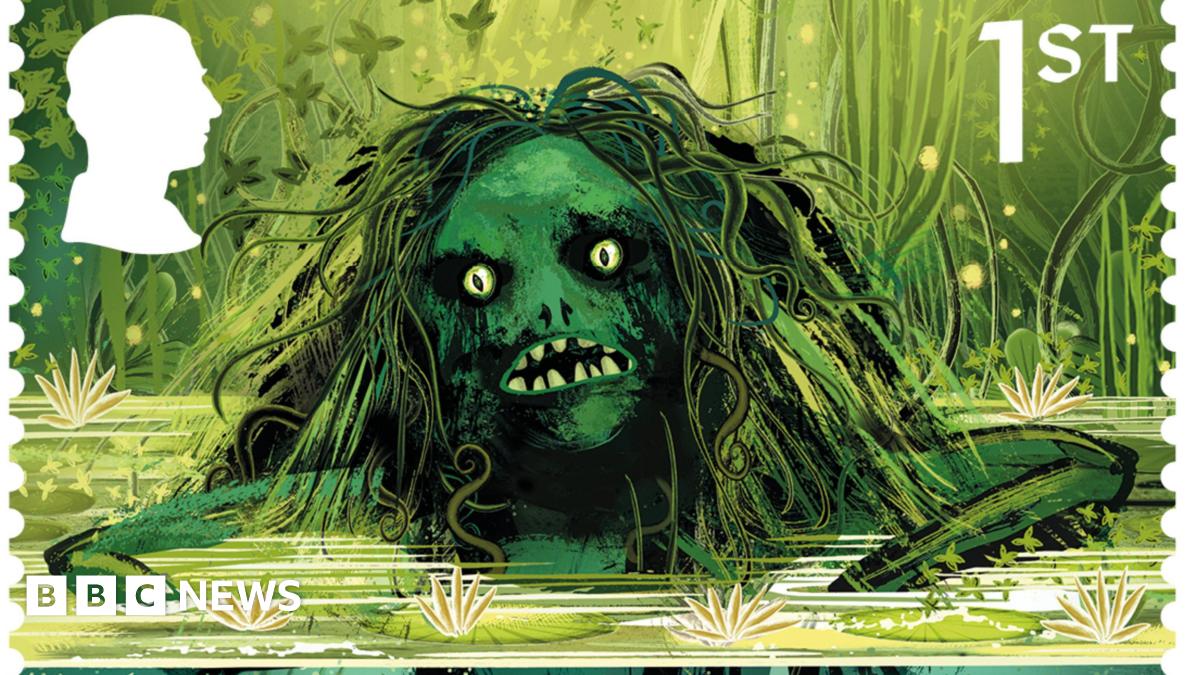
Jenny Greenteeth, the inspiration for Swamp Hag ‘Meg Mucklebones’ (Legend, 1975)
Akin to the Grindylow, Jenny Greenteeth is a nasty Northern English river demon. Also Green-skinned, but boasting long hair and sharp teeth, she too pulls children or the elderly into rivers to drown them.

Doxey Pool, said to be the home of Jenny Greenteeth, is a small pond, measuring about 15 by 10 metres (49 by 33 ft), by the top path of The Roaches in the Staffordshire Peak District. Legend says that she was a hermit woman who fell into the pool on a foggy day whilst walking along the top of the Roaches (hills), and ever since has been enticing unsuspecting victims to the pool and a watery grave.
Naiads and Nereids
Aquatic-dwelling nymphs from classical mythology, seen as protectors of waters, some brought across with the Roman invasion, although there have always been local spirits associated with natural features.
Appearing as lithesome young women, Naiads are found in freshwater and Nereids in the sea.
Mermaid’s Pool, The Peak District
Take a path from the village of Hayfield, Derbyshire, and above the Kinder Reservoir, but below the summit of Kinder Scout, and you’ll find Mermaid’s Pool.

Unusually for an inland lake, the water is salty and if you visit on a blustery day, the nearby waterfall - Kinder Downfall, looks as though the water is flowing upwards. The pool itself supposedly holds supernatural powers. Stories suggest that the waters can heal those who wash in them.
Visit at midnight on Easter Sunday, and a mermaid is said to appear. If she takes a particular liking to you, she’s said to grant you the gift of eternal life. Don’t know what happens if she doesn’t take a shine to visitors though. Drowning, probably.
The Mermaid by Bobby Bare
The Mermaid by The Clancy Brothers
Links:





Stephen Arnell’s novel THE GREAT ONE, is available on Amazon Kindle:
Reviewers have described the writing style as "breezy 21st-century demotic," offering an entertaining take on historical events while staying largely within the bounds of known sources.
Sample: