


London may have been founded as a city by the Romans, but that’s not to say that the area was deserted in the centuries before the invaders arrived. Indeed there are many remnants of prehistoric and Celtic London, if you know where to look for them; some are hiding in plain sight.
These include the mounds and barrows located in London itself, its suburbs and areas close to the conurbation. Theories abound about their previous use, some positing they were part of a network of energy-carrying Ley Lines, carrying magnetic force or even mental power.
In 1914, the ‘four principle sacred mounds of London’ were described by E.O Gordon in his book ‘Prehistoric London – its mounds and circles’, where he attempted to explain the relationship between the mounds and their supposed geometric patterns.
Link to a pdf of Gordon’s work in full:
PREHISTORIC LONDON ITS MOUNDS AND CIRCLES
The Mounds and their siblings
The Bell Barrow on Hampstead Heath tumulus aka Boudica’s/Boudicca’s Grave

This ancient earthwork monument is located in Hampstead Heath (where incidentally Dracula’s "Bloofer Lady" once brought her young victims), with impressive views over the city to the south of its heights.

Historic England summarizes the mound:
The bell barrow called Boadicea's Grave, 650m west of Millfield Cottage survives well. A roughly circular-shaped mound, 36m in diameter and up to 3m high. Around the barrow is a berm or platform varying between 3.5m and 4.5m wide. Surrounding this is a quarry ditch, varying between 4.8m and 6m wide, from which material to construct the barrow was derived. The barrow was partially excavated by Charles Read in 1894 but only pieces of charcoal were recovered. Read concluded that the burial may have completely decomposed given the acidity of the soil. The name of the barrow is derived from a local tradition (untrue) stating it was the site of Boadicea's (or Boudica's) grave. Boadicea was the queen of the Iceni tribe who led an uprising against the occupying Roman forces in about AD 60. The monument excludes the modern path which impinges on the monument, all marker posts, modern fences and fence posts, gates and gate posts but the ground beneath all these features is included.
Caroline White, in her 1900 book Sweet Hampstead and its Associations says:
... “whatever its origin, the mound adds materially to the visual enjoyment of the visitor; and the sight of London from its height, especially at the early dawn of a clear summer’s day, is said to be worth a midnight pilgrimage to obtain. The air blows over its summit ‘most sweetly,’ especially in June, blending the scent of the lime blossoms from the sister villages with the aroma of the hayfields and hedgerows, where the honeysuckle and wild-rose bloom unmolested”.
Tower Hill/ Bryn Gwyn aka ‘The White Mount’

In the collection of Welsh legends called The Mabinogion is the story of the giant Bran the Blessed, King of England. Fatally injured by a poisoned spear in battle, he ordered his followers to decapitate him, and take his head to Gwynfryn (White Hill, now Tower Hill) in London and bury it with its face towards France. The buried head is believed to have kept the island safe from invasion from that direction until none other than King Arthur himself ordered it to be exhumed, claiming no other force than himself was required to defend the island.
Flint flakes and deposits of worn pottery were discovered beneath accumulated layers of sand and gravel during excavations in the south-east corner of the Inmost Ward in 1955 and 1976. Excavations revealed flint flakes and Iron Age pottery along with a shallow grave containing a skeleton of a young male, around 13 – 16 years old, dating from beginning of the first century AD. Pits and pottery of Iron Age date have been uncovered from sites around the Tower.
Present-day Druids congregate at the hill each Spring Equinox to reverence both Bran and the change of season.

The Druid Temple on Navestock Common
“Another ancient earthwork, of which hardly any traces remain, was situated on Navestock Common, by the road from Ditchleys (in South Weald) to Princesgate, near the parish and hundred boundary. It was visited on several occasions in the 18th century by William Stukeley (1687-1765) who described it as an ‘alate temple’.”
“The central mound had been heavily quarried with a circle of trees interpreted as denoting the original edge of the mound. Havis suggests this represents a small motte and bailey or two adjoining baileys to the central motte. It is not clear whether this is the temple referred to by Stukely or if that is located at the western end of Mores wood.”
– Essex County Council
The Penton Mound

Mere minutes from where I dwelt in Amwell Street lies the Penton Mound, also known as the Pentonville Mound, believed to be a former pagan sacred site and a location for a possible Druidic teaching college. Penton being one of four druidic mounds in London, alongside Tothill, White Mound (Tower Hill), and Parliament Hill. Situated along the Pentonville Road heights, the mound overlooked the now-hidden River Fleet. Late on, Merlin the magician supposedly used the prominence to observe the night sky, using a connecting tunnel from his nearby cave to visit the mound of an evening.
The story is rather punctured when one realizes the area is named after Henry Penton, who developed a the streets in the 1770s. Unless it’s a just a coincidence...
Barrow Hill - Parliament Hill

Once home to a burial mound called "Barrow Hill," levelled in the 19th century for a water reservoir, Primrose Hill is celebrated as a holy site by contemporary Druids, with the first public meeting held there in 1717. A plaque is dedicated to Iolo Morganwg, the assumed name and Druidic identity of Welsh stonemason and pagan revivalist, Edward Williams (1747-1826).
Tothill

There are a number of theories as to the origin of the name Tothill. The most likely is that, as the highest point in Westminster, it was a ‘toot’ or beacon hill. Another theory is that it was from the Druid divinity ‘Teut’.
The Greenwich Park Tumuli

Shrewsbury Tumulus in Shooters Hill

Shrewsbury Barrow is a Bronze Age burial mound (also known as a tumulus) in Shooter's Hill in South East London, in the Royal Borough of Greenwich. It is a Scheduled Monument. It is the only surviving barrow of a group of six; or possibly two groups of three.[4] The other barrows were destroyed during the development of the surrounding estate in the 1930s.[5] The barrows are located at the top of the hill, and would have been visible from the foot of the hill, silhouetted against the sky.
“It is a most regrettable fact that six mounds which, perhaps, all contained interesting remains of the people who lived long ago in this district have all been destroyed or plundered and their contents hopelessly lost. The single barrow which has not been opened (No. 6) is fortunately safe from unauthorised relic-hunters. Some day perhaps and with the consent of the London County Council a proper examination of this site may be made."
A Spark in Your Veins: Barrow Quest from December 2020.
A Bronze Age burial mound was discovered near London Bridge during the redevelopment of the No.1 London Bridge complex in 1984:
The Stanwell Cursus
From Archaeology at Heathrow Terminal 5
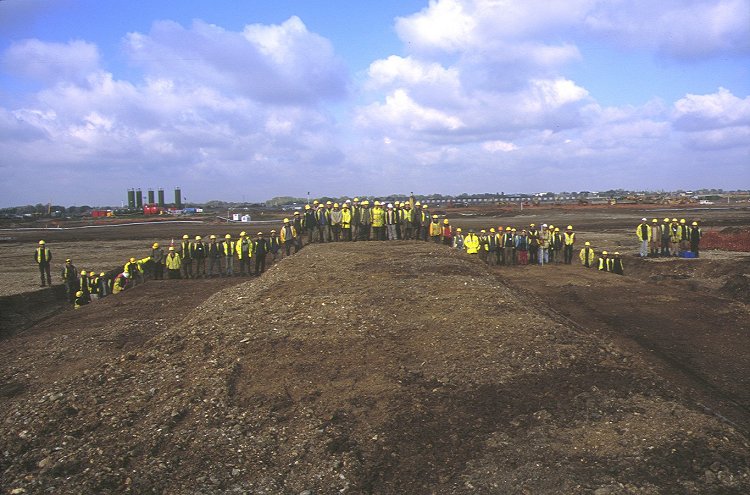
The Stanwell Cursus is a long linear monument constructed of two ditches about twenty metres apart. Soil from the ditches was banked up between them, forming a mound two metres high. The ditches were dug as a series of individual constructions, possibly by family groups. Cropmarks show that the cursus ran for over three kilometres. Early Neolithic pottery found on the base of the ditches suggests that the cursus was in use between 3600 and 3300 BC.
It linked together and overlay important locations in the landscape, including the Mesolithic pit cluster dug over three thousand years earlier and a row of early Neolithic timber post settings. The central bank may have been an elevated processional route, visible to those in the surrounding area.
The Mordern Park Mound, Merton
A large circular earthwork in Morden Park has been identified as a possible burial mound from either the Iron Age, Roman or Saxon periods. Archaeological investigations were carried out in the 1950s, but no conclusive proof as to its date/purpose were found. English Heritage believes that the hillock was remodelled at some time into a viewing platform at some unspecified time.
See also:
Bushy Park Barrow, Teddington

Croham Hurst Barrow, Croydon

Farthing Downs, Croydon

Winn’s Common Mound, Plumstead

Richmond

The Lea Valley Mound

In the early nineteenth century, farmer Joseph Freeman rented a field between Coldharbour Lane and the River Lea from Francis Pym and Charles William Packe, two land owners in Harpenden. In this meadow was a tumulus, roughly fifty feet around the base and twenty feet high. At some date between 1822 and 1830 it was opened and a massive stone sarcophagus of Romano-Celtic origin was unearthed.
Nothing now remains of the tumulus in Coldharbour Lane; it was razed before 1860, to accommodate the construction of the Great Northern Railway.

Some more thoughts in the mounds, filmed at the man-made Stave Hill constructed in the 1980s.
Close to the borders of Greater London:
Montem Mound

Around half a mile west of central Slough (Berkshire) lies the Montem Mound, which was dug around 1,500 years old - the early Anglo-Saxon period, making it a contemporary of Sutton Hoo and nearby Taplow. Until 1847, Eton College held an annual festival here, known as the Eton Montem, or Salt Hill.
The Montem, described by Benjamin Disraeli from his novel Coningsby (1840)
Five hundred of the youth of England, sparkling with health, high spirits, and fancy dresses, were now assembled in the quadrangle. They formed into rank, and headed by a band of the Guards, thrice they marched round the court. Then quitting the College, they commenced their progress 'ad Montem.' It was a brilliant spectacle to see them defiling through the playing fields, those bowery meads; the river sparkling in the sun, the castled heights of Windsor, their glorious landscape; behind them, the pinnacles of their College. The road from Eton to Salt Hill was clogged with carriages; the broad fields as far as eye could range were covered with human beings. Amid the burst of martial music and the shouts of the multitude, the band of heroes, as if they were marching from Athens, or Thebes, or Sparta, to some heroic deed, encircled the mount; the ensign reaches its summit, and then, amid a deafening cry of 'Floreat Etona!' he unfurls, and thrice waves the consecrated standard.
Taplow Barrow - aka "Tæppa's mound"

In the south-eastern English corner Buckinghamshire, not far from Greater London lies Taplow Barrow, the pagan seventh-century Anglo-Saxon monumental tomb of Tæppa, a wealthy nobleman or chief. The barrow is itself located within an earlier Iron Age hillfort. Grave goods, now in the British Museum, included 19 vessels for feasting and drinking, three weapon sets, a lyre, a gaming board, and luxurious textiles.
Another, thankfully vastly more short-lived man-made mound:

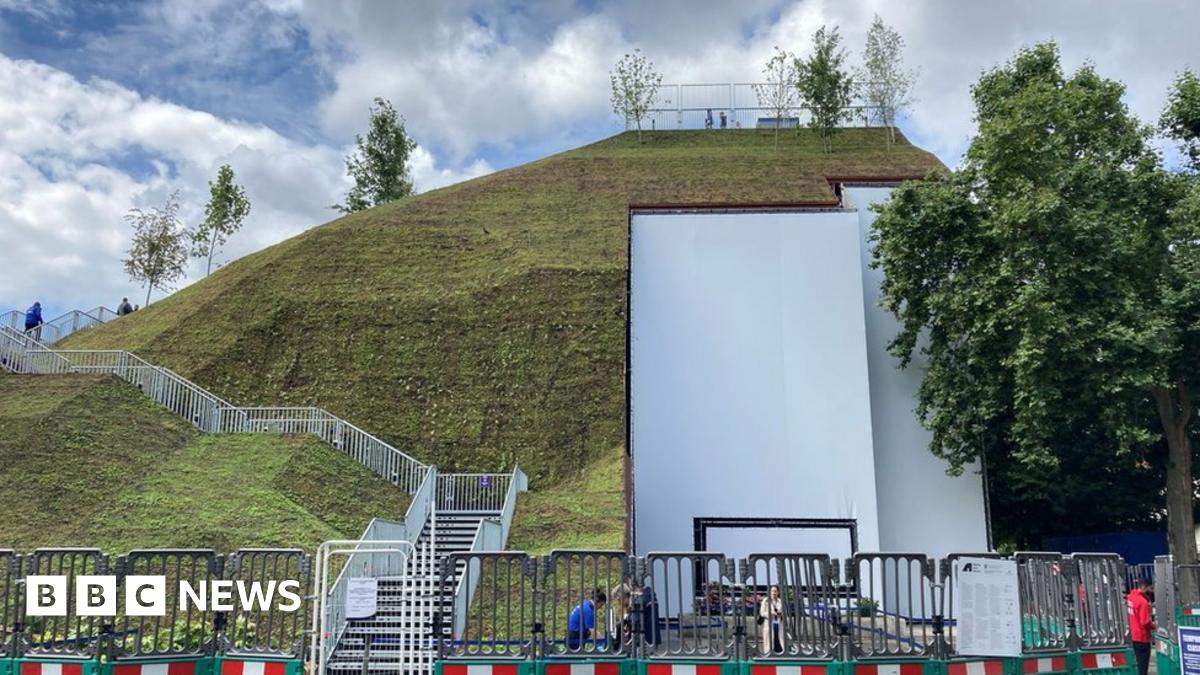
The Marble Arch Mound was a temporary visitor attraction at the end of Oxford Street, London. It opened on 26th July 2021 and closed around just 5th months later on 9th January 2022.
The mound was a vast scaffold structure covered with a plastic fabric fleece thought to resemble grass. To complete the illusion, the mound boasted several potted trees. As a very brief paid attraction, it totally failed- the toilets set up at the site proved the most popular part of the entire fiasco. The mound re-opened with out charge in August 2021.
The Dig (2021)
Barrow Wights - from the awful Rings of Power Season 2
Running Up That Hill - Unsecret Strings
Further Appendices:



.jpg)

_-_Fiona_Lewis_2.png)


Stephen Arnell’s novel THE GREAT ONE is available on Amazon Kindle:
https://www.amazon.co.uk/Great-One-Secret-Memoirs-Pompey-ebook/dp/B0BNLTB2G7
Preview: