


An Underworld Travel Guide - legendary ‘Gateways to Hell’ that still exist in Europe
The ‘Ploutonion’ at ancient Hierapolis (near modern Pamukkale in Turkey) was a religious site and a supposed entrance to hell dedicated to the grim god Pluto, he who ruled over the dead in Hades.
Discovered in 1965 by Italian archaeologists, and followed by studies carried out in 1998, the Ploutonion and the nearby Apollo's Oracle of Hierapolis are linked to a seismic fault, on which both sanctuaries were purposely built as part the Gateway to Hades/Hell/The Underworld. The site has been partially restored, with statues of Hades and his three-headed hound Cerberus now guarding the remains of the complex.
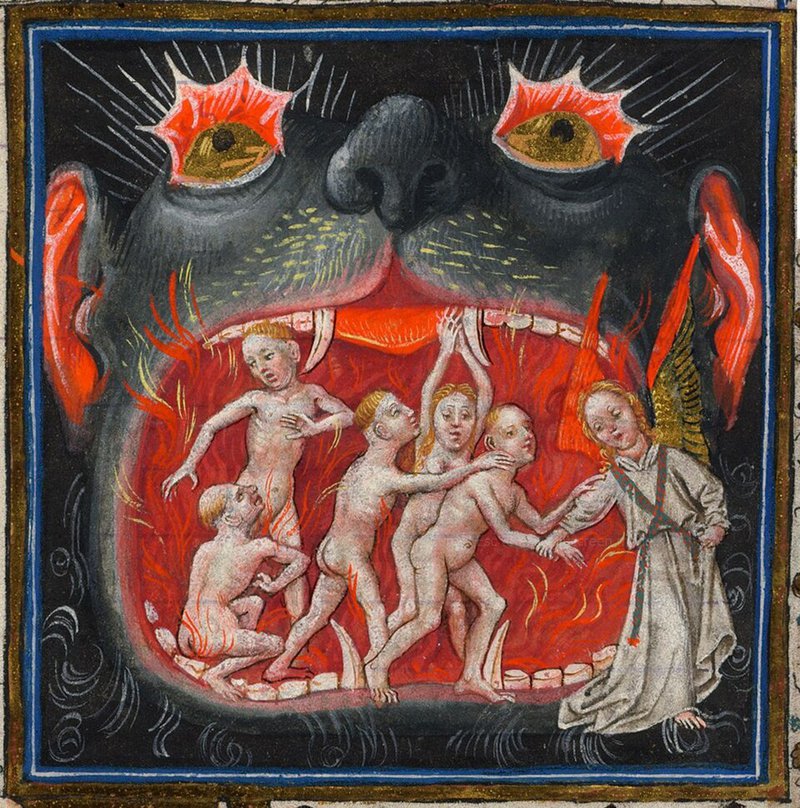
Master of Catherine of Cleves, Public domain, via Wikimedia CommonsPluto’s sanctuary is built on top of a cave which emits lethal toxic gas; animals would be thrown into the cave and pulled back, instantly dead. Fumes emitted from the cavern are still fatal; passing birds have suffocated after breathing the fumes emanating from the site.
Lethal gas said to be sent by Pluto, god of the underworld
The Ploutonion is a small cave, large enough for one person to enter. Behind the roofed chamber is a deep cleft, through which fast-flowing hot water passes, releasing the lethal gas, said to be sent by Pluto, god of the underworld. The fumes were so strong they could kill a human within just one minute of exposure.
Gelded priests of Cybele (‘the Galli’) descended into the chamber, crawling on the floor to inhale pockets of oxygen, or simply holding their breath. They then returned to the surface claiming a miracle had occurred and they were uniquely under Pluto’s protection.
In front of the ‘Gateway’ an enclosed area of 22,000 square feet was covered by the swirling, deadly gas, instantly killing many who dared to enter this area, except for the wised-up servants of Pluto who were aware the gases pooled closer to the ground, so kept their mouths and noses above the deadly clouds below; unlike the animals (including bulls) that were led to their deaths. The acquisitive priests naturally sold birds and other animals to visitors, who used them to test the deathly air as sacrifices. But their regular exposure to the CO2 in the surrounding atmosphere would have doubtless contributed to the hallucinations and eccentric behaviour displayed by the Pluto’s servitors.
Greek historian Strabo (63 BC – c. 24 AD) described the gate: “Any animal that passes inside meets instant death. I threw in sparrows and they immediately breathed their last and fell.”
For a fee, supplicants asked questions of Pluto’s human oracle, again topping up the sanctuary’s coffers; but when Christianity came to dominance, the area was closed off, and in time largely forgotten. The temple was mostly destroyed by an earthquakes in the 6th century AD.
But Pluto’s shrine is still deadly to some foolish enough to test the god.
Other ‘Hellgates’
The Roman Forum - home to no less than two entrances to Hades’ realm:
The Lacus Curtius
I’m a regular visitor to Rome’s fascinating ancient Forum; two sites are of particular interest to the investigators of esoterica.
The Lacus Curtis is arguably the most mysterious monument of the Roman Forum. The name suggests it was a lake, becoming smaller as drains were constructed, until a small dodecagonal basin was all that remained, called the Lacus Curtius. The Romans had three stories explaining the name. The first was that in 445 BC, lightning struck the area, and consul Gaius Curtius Philo ordered the construction of a fence around it. Livy (59 BCE - 17 CE) tells us that after the Rape of the Sabine Women, war broke out between the Romans and the Sabines, Roman champion Mettius Curtius, drowned in the marsh during the clash which was thereafter called the Lake of Curtius.
The third and most popular account says in 362 BC a great fiery cleft to the Underworld opened in the Roman Forum; seers claimed that to seal the fissure, Rome must throw "that what constituted the greatest strength of the Roman people" into the ravine. If they did so, Rome would last forever. The knight Marcus Curtius mounted his horse, pronouncing that youth was the most important thing, and jumped into the chasm, which then promptly closed.
To the east of the Lacus, the skeletons were discovered of a child, a woman and a man that were bound together and drowned in the lake, perhaps the victims of an ancient ritual, in which people were sacrificed by drowning ; perhaps the three were the profaners noted on the inscription on the nearby Black Stone (Lapis Niger).
Whosoever (will violate) this (grove), let him be cursed. (Let no one dump) refuse (nor throw a body ...). Let it be lawful for the king (to sacrifice a cow in atonement). (Let him fine) one (fine) for each (offence).
The Lacus Curtius was the place where the aged emperor Galba was lynched by soldiers on the fifteenth of January 69.
Umbilicus Urbis Romae/Mundus
When Romulus founded the city, he instructed a circular pit be dug in the Forum. The first fruits of the year were then thrown in as a sacrifice; apparently in archaic times all new citizens of Rome had to throw in a handful of dirt from their place of origin. The Mundus was an underground structure considered a gate to the underworld, ritually opened just three days each year. These days were dies nefasti—on which official transactions were forbidden on religious grounds, because evil spirits rose from the Underworld to wander the city.
Porta Alchemica, aka The Alchemical Door, The Magic Portal or The Alchemy Gate
A way not to the Underworld, but to somewhere else...the mysterious.

Master of Catherine of Cleves, Public domain, via Wikimedia CommonsThe Alchemical Door, also known as the Alchemy Gate or Magic Portal (Italian: Porta Alchemica or Porta Magica), was built between 1678 and 1680 by Massimiliano Palombara, marquis (nobleman) of Pietraforte, in his residence the villa Palombara, located on the Esquiline Hill, near Piazza Vittorio in Rome. This is the only one of five former gates of the villa that remains.
In a story collected by Francesco Cancellieri in 1802, a pilgrim suspiciously named ‘Stibeum’ (‘Antimony’ - a brittle silvery-white poisonous metal) was a guest in the villa for a night. That night, the pilgrim, identified later as alchemist Giuseppe Francesco Borri/Giustiniano Bon, scoured the gardens of the villa in search of an obscure herb capable of concocting gold. The next morning, he disappeared through a door, leaving behind flakes of gold and a mysterious paper full of puzzling symbols and equations, describing the ingredients and transmutative process required.
The marquis had these symbols engraved on the five gates of the villa Palombara and on the walls of the mansion, hoping that one day they would be translated. Another legend holds that between 1678 and 1680, the same Giuseppe Francesco Borri along with Athanasius Kircher and Gian Lorenzo Bernini, designed and built the gate for the marquis. The marquis Palombara developed a passion for alchemy in 1656, when he visited the alchemical laboratory in Riario Palace, now known as Palazzo Corsini. It was rumoured that Palombara, Bernini and Kircher were all poisoned on 28 November 1680, probably by Borri, for having revealed the secret formulas through the inscriptions on the gate. Cancellieri published his account in 1806, including his interpretation of the inscriptions on the Porta Alchimica. His work was published much later in June 1895 in French by Pietro Bornia as an issue of the periodical L'Initiation.
Inscriptions on the Porta Alchemica include alchemy symbols and incantations
Around the circle at top: “The centre is in the triangle of the centre.”
Also: “There are three marvels: God and man, mother and virgin, triune and one.” And the Hebrew inscription, Ruach Elohim, meaning “Spirit of God.”
Beneath: “The Hesperius dragon guards the entrance of the magic garden, and, without Alcides, Jason would not have tasted the delights of Colchis.”
There are six sigils on the jambs, each with its phrase.
Saturn/Lead: “When in your house black crows give birth to white doves, then you will be called wise.”
Jupiter/Tin: “The diameter of the sphere, the tau of the circle, the cross of the globe do not benefit the blind.”
Mars/Iron: “He who can burn with water and wash with fire, makes heaven from earth and precious earth from heaven.”
Venus/Bronze: “If you will make the earth fly upon your head, you will convert the waters of torrents to stone by its feathers.”
Mercury: “Azoth and Fire: by whitening Latona, Diana will come without dress.” Antimony: “Our son lives dead, the king returns from the fire, and enjoys the occult conjunction.”
On the base, Vitriol: “It is occult work of true wise to open the earth, so as he may germinate health/safety for people.”
In another plate, now lost, was the device VILLAE IANUAM TRANANDO RECLUDENS IASON OBTINET LOCUPLES VELLUS MEDEAE 1680 (Passing by opening the door of the villa, Iason obtained the rich fleece of Medea 1680).
And on the doorstep, “SI SEDES NON IS,” a palindrome, meaning both “If you sit, you do not go,” and “If you do not sit, you go.”
The Statues
The figures on both sides of the ‘door’ represent the Egyptian god/semi-divinity Bes. A patron of the home, childbirth, and infants in ancient Egypt, Bes was well-known in imperial Rome, where in pre-Christian age several people followed Egyptian cults.
Originally, the statues were found on the Quirinal Hill, where there once stood a huge temple dedicated to the Egyptian gods Isis and Serapis; over centuries its rich decorations, reliefs and small obelisks were dug up and ‘relocated’ to ornament different parts of the city.
In 1888, during the works for the opening of Piazza Vittorio, the statues were moved from their original location to the Porta Alchemica - and therefore were not part of the original design.
And briefly, some other European ‘hellmouths’
The lake at Lerna, Greece
Lerna was one of the entrances to the Underworld, and one could gain entry to the netherworld via the Alcyonian Lake. The lake is called "the Lake of Darkness" in Shakespeare's King Lear.
According to Pausanias (110-180 AD), “There is no limit to the depth of the Alcyonian Lake, and I know of nobody who by any contrivance has been able to reach the bottom of it since not even Nero, who had ropes made several stades long and fastened them together, tying lead to them, and omitting nothing that might help his experiment, was able to discover any limit to its depth. This, too, I heard. The water of the lake is, to all appearance, calm and quiet but, although it is such to look at, every swimmer who ventures to cross it is dragged down, sucked into the depths, and swept away.”
Cave of the Sibyl, Cumae, Italy

Carole Raddato from FRANKFURT, Germany, CC BY-SA 2.0, via Wikimedia CommonsThe Cumaean Sibyl was a priestess who presided over the Apollonian oracle at Cumae, a Greek colony near Naples. Her cave was discovered by Amedeo Maiuri in 1932, basing his identification on the description by Virgil in the 6th book of the Aeneid. The cave is a trapezoidal passage over 131m long, running parallel to the side of the hill and cut out of the volcanic tuff stone, and leads to an innermost chamber where the Sibyl was thought to have prophesied, aided by volcanic fumes direct from Hades, or perhaps additional pharmaceutical help. A younger Claudius consulted the Sibyl in I Claudius:
“What groans beneath the Punic curse and strangles in the strings of purse before she mends must sicken worse. Ten years, fifty days and three, Clau-Clau-Claudius shall be given thee a gift that all desire but he. But when he's done, and no more here, nineteen hundred year or near, Clau-Clau-Claudius shall speak clear.”
"The hairy sixth to enslave the State/ Shall be son, no son, of this hairy last./ he shall give Rome fiddlers and fear and fire./ His hand shall be red with a parent's blood./ No hairy seventh to him succeeds/ And blood shall gush from his tomb." (Referring to Nero)
A tunnel complex in nearby Baiae (part of the volcanically active Phlegraean Fields) leads to an underground, geothermally heated stream that conforms to the description in the Aeneid of Aeneas's journey to the underworld and back
Lake Avernus, Italy
Lake Avernus was once synonymous with Hell/the Underworld. Its name means ‘birdless’ in classical Greek, due to the toxic fumes (them again) seeping from the area, which, like Cumae, is part of the Phlegraean Fields of dormant/semi-active volcanoes. The ancient Roman believed Lake Avernus was the entrance to Hades, and its name grew to be a synonym for the underworld itself. In Virgil's Aeneid, Aeneas descends to Hades through a cave near the lake.
St. Patrick’s Purgatory, Ireland
Christian tradition links Patrick to Ireland’s Station Island (Lough Derg, County Donegal), where Christ showed St Patrick a cave, sometimes referred to as a pit or a well, that was an entrance to Hell. Legend maintains that St. Patrick was depressed by the doubts of his potential converts, who demanded proof of the Creed. St. Patrick earnestly prayed to God to aid him in converting the heathen Irish, and in return, Jesus revealed to him the hole where Purgatory could be seen; a place in which the joys of Heaven and torments of Hell may apparently be glimpsed rather than actually experienced. This supposedly convinced those pagan-backsliders who gaped into the chasm. Not technically an underworld entrance to Hell, but more a spiritual peep-show of sorts.
The cave has been closed since October 25th 1632, but descriptions by early pilgrims survive, referring to it as a cave or cellar or an enclosed pit. The entrance was narrow: about 0.6 m (2 ft) wide and 0.9 m (3 ft) high. Once inside there was a short descent of about six steps. The cave was divided into two parts: the first was about 3 m (9 ft) long, probably with banked sides and only high enough to kneel in; after a turn there was another niche about 1.5 m (5 ft) long.[5] The site has never been excavated, so we can only rely at this point on these descriptions of the cave. It was probably an ancient pre-Christian structure, likely an ancient sweat house. People would enter these enclosed places to inhale medicinal smoke produced by burning various plants, a place that people went to for physical or spiritual healing of some kind.
Cape Matapan Caves, Greece
The caves at Cape Matapan lie at the end of the Mani peninsula in Greece. The entrance to the caverns is located at sea level, leading to chambers under the cliff face; marked by the ruins of a Spartan temple on top of the cliff. The Ancient Greeks believed in several different entrances to the underworld, of which Matapan is the most famous.
Mount Etna
Etna was thought in ancient times to be the forge of Hephaestus, the Greek god of fire and blacksmithing. The rumbling of the volcano was assumed to be the hammer of Hephaestus striking his anvil. Etna was also believed to be a gateway to Hell.
In later times, the Devil left his footprint on the volcano and he whisked Elizabeth I there as she lay dying.
Hekla, Iceland
Iceland’s Hekla volcano was believed to be another ‘Gateway to Hell’. The activity at Hekla, which includes lava flows and fountaining, looking like a veritable Hell on Earth; birds that were seen flying in the area were thought to be damned souls queueing to enter the Pit. Hekla still carries an evil aura for the superstitious, for they claim it is where witches gather to meet Satan himself.
Houska Castle
Houska Castle in the Czech Republic is infamous for a legend claiming it was built over another toxic "Gateway to Hell". The gassy fissure was allegedly so deep that no one could see the bottom of it; animal-human hybrids supposedly crawled out of it, and dark-winged, otherworldly creatures flew in the vicinity. When construction began on the castle, prisoners that were sentenced to death were offered a pardon if they agreed to be lowered by rope into the hole, and reported back on what they saw. When the first person was dangled, he began screaming after a few seconds, and when pulled back to the surface, he looked as if he had aged 30 years. Houska’s inhabitants include a bullfrog/human creature, a headless horse, and an old woman as well as the remains of "demonic beasts who escaped the pit".
Fun Fact: the courtyard walls face inwards, as if to keep something in.
The castle was the inspiration for Michael Mann’s 1983 motion picture The Keep? - especially since in World War II, the Wehrmacht occupied the castle and the Nazis were said to have conducted occult experiments there.
Cresswell Crags
Creswell Crags is an enclosed limestone gorge on the border between the English counties of Derbyshire and Nottinghamshire. Its caves contain the northernmost cave art in all of Europe, as well as hundreds of later ‘witch marks’ recently discovered there. One collection of scratchings, carved around a four-foot round hole in one of the caves, is said to warn of an entrance to the Underworld.
Hell’s Gate, the East Riding of Yorkshire
Close to the Cresswell Crags, but not really an entrance to Hell as such, but the burial place of thirteen decapitated Anglo-Saxon ‘criminals’. Their heads had probably been displayed on poles as warnings to others, a known practice in Anglo-Saxon England. The use of an ancient pre-Saxon barrow site for the mass grave indicates the executed were excluded from the community, even unto death. The site had been known locally as ‘Hell's Gate’ – suggesting an enduring folk memory from its days as a public execution site.
More Eerie Underworld Entrances
The are other entrances to Hades in the UK, including close to where I currently live.
Marston Moretaine’s (Bedfordshire) - Devil's Stone, marks the spot where Old Nick played a game of leapfrog with three foolish local lads. When they leapt over his back, an entrance to hell opened, and they were never seen again. The Horned One was showing off his muscles to villagers and lifted the tower away from the main body of the building, but had to drop it when his back hurt.
Not an entrance to hell as such - but of interest I hope to readers; standing outside the west side of St Giles-in-the-Fields in central London, is a gateway built in 1800 by William Leverton.
This is actually a cast of a much earlier original oak panel, kept inside the church, apparently carved in 1687 by someone called Love. It depicts the Resurrection, with Jesus standing in the centre while angels proclaim judgement day and cadavers clamber out of the graves to await their fate. One side shows the godly ascending to heaven (at the right hand of God), the other those fated to eternal damnation.
From Ornamental Passions:
The tympanum depicts Christ bursting onto the world in a blaze of light, announced by angels with trumpets filling the sky. Beneath his feet, a nasty little imp with bat's wings, tail and claws scuttles off to her master, Satan, who stands in the mouth of Hell at the bottom right hand corner (which is on Christ's left, or sinister, hand). Flames and smoke belch from the infernal regions, as sinners are dragged down to eternal torment. All along the bottom, graves spring open and the dead arise, some as skeletons, others as rather gruesome shrouded corpses. An angel holds a naked man with one hand, pointing heavenwards with the other. Another man grasps him by the leg, hoping to get a lift to glory. Two women sing and play the harp as they arise.
Extra:
Hellam Township in the US, near York, Pennsylvania, is the subject of a modern urban legend claiming that it contains the Seven Gates of Hell.
Plus some related motion pictures:
The Gate (1987)
Antrum (2018)
As Above, So Below (2014) - ‘The Gates of Hell’ scene
Stephen Arnell’s novel THE GREAT ONE is available on Amazon Kindle: https://www.amazon.co.uk/Great-One-Secret-Memoirs-Pompey-ebook/dp/B0BNLTB2G7
Sample Chapter:
Judas Priest - Gates of Hell
References
https://www.smithsonianmag.com/history/the-unsolved-mystery-of-the-tunnels-at-baiae-56267963/
https://vcorner.medium.com/cape-matapan-taenarum-exploring-the-mythical-gateway-to-hell-bdda8cd3df35
https://www.go-etna.com/blog/a-pidata-du-diavolo-the-devils-footprint/
https://www.fodors.com/news/photos/10-eerie-places-that-are-said-to-be-the-actual-gate-to-hell
https://www.atlasobscura.com/places/hellam-township
https://www.hulldailymail.co.uk/news/history/east-yorkshires-hells-gate-what-8537988
