


When rival ‘Vampire Hunters’ David Farrant and Sean Manchester feuded over who was to slay the King of the Undead
On Halloween night 1968, a group of young people fascinated by the occult chose to visit Tottenham Park Cemetery. The London Evening News of November 2nd 1968 reported:
“These persons arranged flowers taken from graves in circular patterns with arrows of blooms pointing to a new grave, which was uncovered. A coffin was opened and the body inside "disturbed". But their most macabre act was driving an iron stake in form a cross through the lid and into the breast of the corpse.”
Later opinion was that this incident was the opening salvo in what became the Affair of The Highgate Vampire.
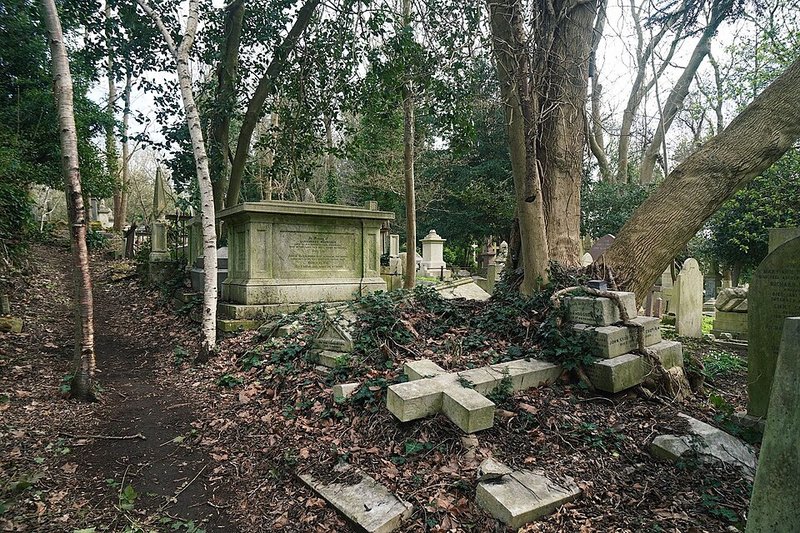
scotbotwylie, CC BY 2.0, via Wikimedia CommonsIn a letter to the Hampstead and Highgate Express on February 6th 1970, budding paranormal investigator David Farrant claimed when he passed Highgate Cemetery on the evening of Christmas Eve 1969 he espied an eerie, unearthly "grey figure", and asked readers if they had seen anything similar. Which kind of begs the question why he didn’t mention the sighting earlier.
“On three occasions I have seen what appeared to be a ghost-like apparition, last week the figure appeared only a few yards inside the gates. This time it was there long enough for me to see it much more clearly.”
February 13th 1979: replies to Farrant’s letter list a variety of ghosts stalking both the cemetery and nearby Swain's Lane. These include an unnaturally tall man in a hat, a spectral cyclist, the usual woman in white, a spooky face glaring through the bars of a gate, a pale gliding figure, bells ringing, and hoarse voices calling. Drunks? Druggies? Satanists?
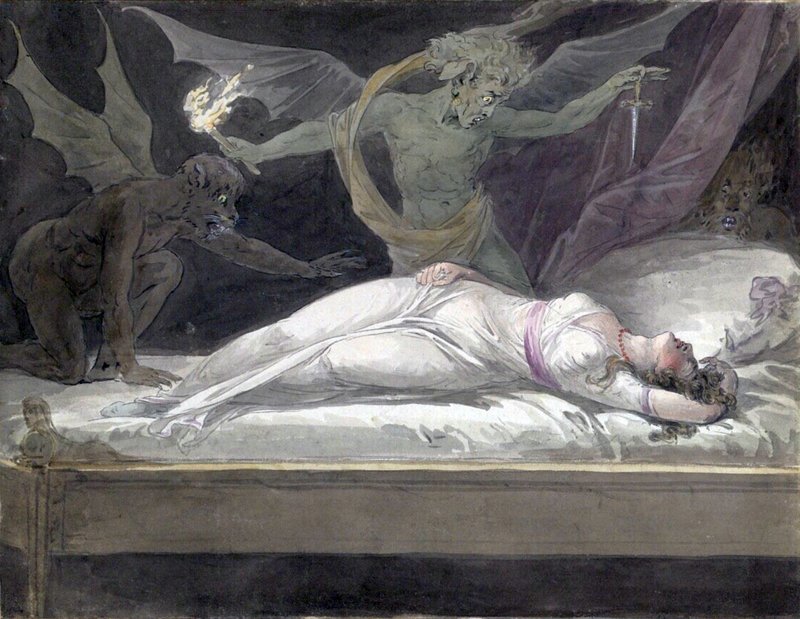
Vincenz Georg Kininger, Public domain, via Wikimedia CommonsSean Manchester, another would-be supernatural sleuth and president of the British Occult Society claimed Farrant's "grey figure" was ”The King of The Vampires” with an accompanying Satanic cult; the media ran with the story.
March 1970: The Villagers Storm Highgate Cemetery
Growing publicity fuelled the rivalry between Farrant and Manchester, who each claimed that they could either expel or exterminate the vampire.
Manchester got in first, pronouncing he would hold an exorcism appropriately enough on Friday 13th March 1970. Early that evening, Thames TV interviewed Manchester, Farrant and others who claimed to have seen supernatural figures in Highgate cemetery. Within two hours, a mob of 'hunters' from all over London gathered and swarmed over gates and walls into the locked cemetery, overcoming the police cordon.
August 1st 1970: the burnt and headless remains of an adult female were discovered not far from a catacomb in the cemetery. The police suspected that it had been used in a black magic ritual. One night the same month, they found David Farrant in the churchyard, equipped with a crucifix and a wooden stake. He was arrested, but the case was dismissed.
Just a few days later Manchester tried his hand; this time he and his companions forced open the doors of a family vault (indicated by his ‘psychic helper’) at the cemetery. A companion prevented him driving a stake through a corpse he found in one of the coffins there. Frustrated, Manchester slammed the coffin shut, leaving garlic and Christian incense in the vault.
Captain Kronos: Vampire Hunter (1974)
Farrant and Manchester (later a bishop in the so-called ‘Old Catholic Church’) generated further headlines when they announced a "Magicians' Duel" on Parliament Hill on Friday 13th April 1973 - which was called off at the 11th hour. Farrant was imprisoned for four years and eight months in July 1974 for damaging tombstones and ‘interfering’ with cadavers in Highgate Cemetery. Vandalism and desecration Farrant claimed had been caused by Satanists, not him.
From The Observer on the Vampire Hunters:
Farrant and Manchester were regulars at the Woodman pub at the bottom of Muswell Hill Road. Though different in appearance and temperament – Farrant was willowy and garrulous, clad in frilly shirts and drainpipe trousers; Manchester, thicker-set and self-serious in flowing capes and natty bow-ties – the two men shared a flair for publicity. If Farrant was initially reticent about the vampire claims, Manchester – who boasted of a direct lineage to Lord Byron – was adamant.
The pair wrote and spoke often about the Highgate Vampire, each claiming to be the hero of the affair.
From Manchester:
“Farrant might make an interesting case study for the psychiatrist in search of a project concerning narcissistic personality disorders, or a priest specialising in the examination of demonic possession brought about by compulsive dabbling in pseudo-occultism for publicity.”
Farrant’s supporters, meanwhile, claimed:
“[Manchester] is [a] bitter old pensioner who spends all his waking hours perpetuating [the feud] from his study in Bournemouth. And when he’s not busy doing that he is stalking, trolling and intimidating his critics.There is something unpleasantly toxic about this mild-mannered, nervous, stammering creature whose stoop, combined with what appears to be an advanced stage of anorexia, puts one in mind of… Dickens’s Uriah Heep”. The Observer
The feud continued for decades, distinguished by insults and petty vindictiveness, until Farrant died in April 2019.
From The National Geographic (October 26, 2016)
Seán Manchester, the president of the British Occult Society, said that a vampire was causing people to see strange things in London’s Highgate Cemetery. Newspapers had already covered reports of a tall figure with burning eyes and other spectral sights floating in the cemetery, and journalists quickly picked up Manchester’s theory that these sightings were the work of an eastern European vampire. Newspapers even embellished his claims a bit, calling the figure a “king vampire,” or writing that the vampire had practiced black magic in Romania before traveling to London in his coffin. In 1970, Manchester told a TV news team that he planned to exercise the vampire on Friday the 13th. That night, hundreds of young people turned up at Highgate Cemetery to see him perform an exorcism (which he ended up not doing). The Highgate panic wasn’t a case of vampires being scapegoated for disease but rather a media sensation and an instance of “legend tripping” (young people going to a supposedly haunted place to test their bravery). In the history of vampire legends, the Highgate incident is a modern phenomenon. It has less to do with the desire to control a community’s health and a lot more in common with modern scares, like the creepy clown sightings that went viral this year—even if people don’t believe it, they’re still drawn to the hype.
The Eerie Vampire Haunting of Highgate Cemetery: David Farrant
Manchester’s account in his 1985 book ‘The Highgate Vampire’:
“With a mighty blow, a sharpened shaft of wood impaled the creature’s heart. We witnessed the body shell cave in and quickly turn filthy brown and that itself soon became a sluggish flow of inhuman slime and viscera in the bottom of the casket.”
Hammer Film Productions, Public domain, via Wikimedia CommonsIn fact, (again in The Observer), unexplained events took place in the area before Farrant and Manchester came on the scene:
In 1967, two teenage girls walking home along nearby Swains Lane claimed to have witnessed the dead rising from their graves by the cemetery’s north gate. Another young woman had woken one night with “something cold and clinging” on her hand that left prominent marks the next morning. Further reports mentioned a “tall man in a hat” wandering through the streets, before melting through the cemetery’s thick stone walls.
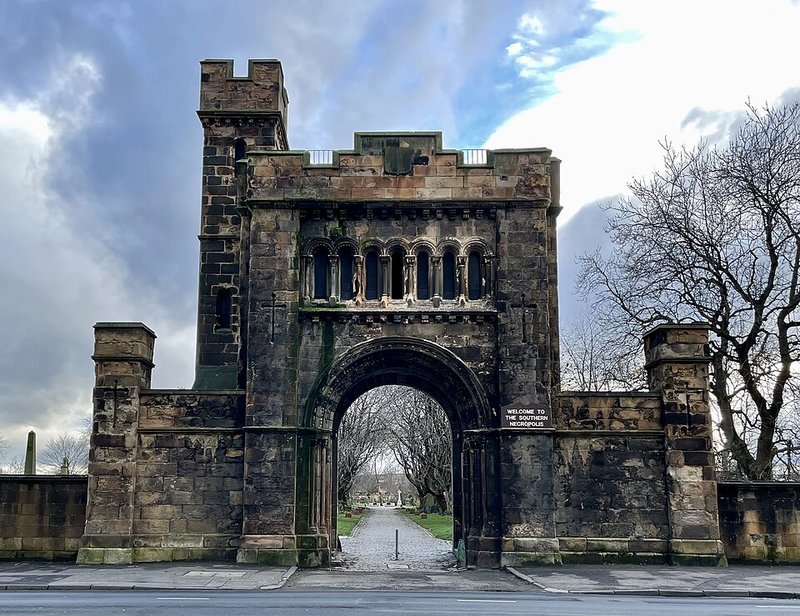
https://commons.wikimedia.org/wiki/File:Glasgow%27s_Southern_Necropolis_gatehouse.jpgIn September 1954, Glasgow also saw a vampire hunt, where hundreds of children swarmed into the city’s Southern Necropolis in search of a being known as the ‘Gorbals Vampire’, a 7ft tall monster with iron teeth. Apparently inspired by a US Dark Mysteries comic from 1953 entitled ‘The Vampire with Iron Teeth’.
Exploring Dracula's London
The Bag of Beard Theatre Company produced a play titled 'The Highgate Vampire', at The Glitch Theatre, London. The show transferred to the Omnibus Theatre and thence to The Cockpit, North London:
LINKS
The Highgate Vampire – Did a 1970s Nosferatu Stalk a London Cemetery? - David Castleton Blog - The Serpent's Pen: https://www.davidcastleton.net/highgate-vampire-highgate-cemetery-london/
The Bloody Truth About Vampires: https://web.archive.org/web/20161027134803/http://news.nationalgeographic.com/2016/10/vampires-europe-new-england-halloween-history/
The Highgate vampire: an urban legend that refuses to die: https://observer.co.uk/style/features/article/the-highgate-vampire-an-urban-legend-that-refuses-to-die-25f1
Episode 388: The Vampire Hunters of Highgate Cemetery: https://directory.libsyn.com/episode/index/show/lpotl/id/11790626
Highgate Vampire: https://vampires.fandom.com/wiki/Highgate_Vampire
The Highgate Vampire Announced as Inaugural Stephen Joseph Transfer at The Cockpit:https://theatreweekly.com/the-highgate-vampire-announced-as-inaugural-stephen-joseph-transfer-at-the-cockpit/
The Gorbals Vampire: https://folklorescotland.com/the-gorbals-vampire/
The Re-Post with Iron Teeth: The Gorbals Vampire Myth: https://thehorrorsofitall.blogspot.com/2010/03/re-post-with-iron-teeth-gorbals-vampire.html

